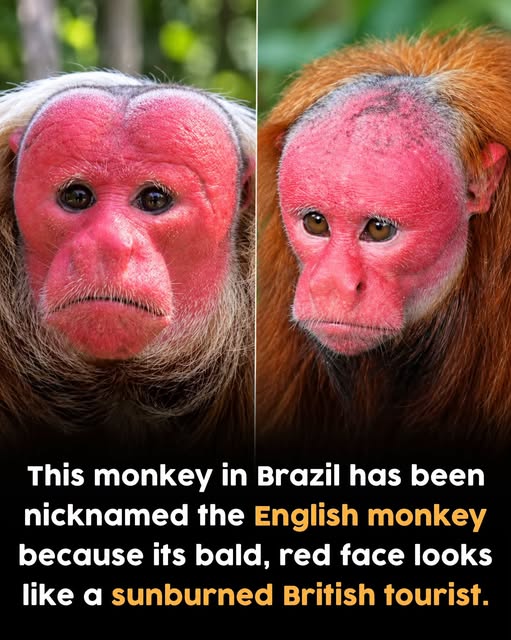
This monkey looks like it got sunburned — and that’s why locals call it the “English monkey.”… See more
Deep in the flooded forests of the western Amazon lives a monkey that looks as though it has spent a little too much time standing beneath the tropical sun.
Its body is covered in pale, shaggy fur, while its head is almost completely bald. But the feature that immediately grabs attention is its face: intensely red, almost as though someone has painted it with bright crimson pain
This unusual primate is the white uakari, one of the Amazon’s most distinctive monkeys. And, according to a colorful local story, its appearance has earned it a rather amusing nickname: the “English monkey.”
The explanation is almost too perfect.
The story says that early English explorers arriving in the Amazon had pale faces that became remarkably red after spending time beneath the powerful tropical sun. To local people, the combination of a pale complexion and a bright-red face apparently looked surprisingly similar to the strange-looking monkey living in the forest.
The comparison stuck.
Whether every detail of this story can be historically verified is another matter, but the nickname makes for an entertaining example of how people have always used familiar human experiences to explain unusual animals.
Of course, the white uakari isn’t actually sunburned.
Its remarkable red face has a fascinating biological explanation—and that explanation may tell other monkeys something important about the animal’s health.
Meet the White Uakari
The white uakari is a member of the uakari group of New World monkeys. It is particularly associated with the seasonally flooded forests of the western Amazon, where its life is closely tied to the rhythms of the rainforest.
Uakaris are unusual-looking monkeys even by Amazonian standards.
The white uakari has a relatively short tail compared with many other monkeys. Instead of using a long tail as an important climbing aid, it relies heavily on its powerful arms and legs as it moves through the forest canopy.
Its coat is generally pale, helping create an extraordinary contrast with its face.
Then there is that face.
Unlike many mammals, the white uakari has extremely sparse hair on its head, exposing the skin underneath. The skin is highly vascularized and contains relatively little pigment, allowing blood vessels close to the surface to show through.
The result is the uakari’s famous crimson complexion.
From a distance, it can look almost unreal.
Imagine seeing a pale, shaggy monkey suddenly appear among the green leaves, staring down at you with a completely bald, bright-red face. It is easy to understand why humans have developed stories and nicknames around such an unusual creature.
Why Is Its Face So Red?
The obvious explanation might be sun exposure.
After all, humans can develop red skin after spending too much time in intense sunlight. The comparison is especially tempting in a place as hot and bright as the Amazon.
But the uakari’s red face is not simply a case of getting too much sun.
The color is primarily produced by the way light interacts with the monkey’s thin, lightly pigmented facial skin and the blood flowing through the vessels beneath it.
In other words, the red appearance is essentially a biological window into the animal’s circulatory system.
Because there is relatively little pigment and little insulating fat beneath the facial skin, the blood vessels underneath can be unusually visible.
That gives the face its striking coloration.
And this is where the story becomes even more interesting.
The red face may not merely be an accidental feature. Scientists have suggested that facial coloration can provide information about an individual’s condition.
In healthy animals, strong blood flow can contribute to a vivid red appearance. Changes in health or condition may affect the intensity of that coloration.
So the face that looks like a tropical sunburn may actually function as something closer to a biological billboard.
A Face That May Reveal Health
For many animals, appearance can communicate information.
Bright feathers, elaborate antlers, colorful skin and dramatic displays can all play roles in attracting mates, establishing social relationships or communicating physical condition.
The uakari’s face is particularly fascinating because its coloration may be connected to health.
A strong red coloration can indicate good circulation and, potentially, good physical condition. That makes the face useful not just for identification but potentially for social signaling.
It is one of those remarkable examples of evolution producing something that looks bizarre to human observers but may make perfect sense within the animal’s own world.
To us, the white uakari looks as though it has been sunburned.
To another uakari, that red face may communicate something entirely different.
It may say: healthy, vigorous and worth paying attention to.
The “English Monkey” Legend
This is where the human story enters the picture.
The nickname “English monkey” is often connected with a tale about European explorers encountering the Amazon and local people comparing the explorers’ sun-reddened faces with those of the uakari.
The image is easy to visualize.
A group of pale-skinned European travelers arrives in an environment dramatically different from what they are accustomed to. Under the intense equatorial sun, their exposed skin becomes red.
Nearby, the forest contains monkeys with pale bodies and naturally bright-red faces.
The resemblance would certainly have been memorable.
Over time, such observations can become stories, jokes and local nicknames. And animal names are often shaped by exactly these kinds of human observations.
It is important, however, to distinguish an entertaining legend from firmly documented zoological history.
The biological explanation for the uakari’s red face is well understood. The precise origin and historical spread of the “English monkey” nickname are much harder to establish with certainty.
That uncertainty doesn’t make the story useless. Instead, it illustrates something fascinating about the way humans interact with wildlife.
We don’t simply observe animals.
We compare them with ourselves.
We give them personalities, nicknames and stories. Sometimes those stories survive for generations.
Life in the Flooded Forest
The white uakari’s unusual appearance is only one part of its story.
Its environment is equally remarkable.
Much of the western Amazon is shaped by seasonal flooding. Rivers rise and spread across enormous areas of forest, temporarily transforming the landscape.
For animals living there, this means the forest itself changes throughout the year.
Trees that appear to stand on dry ground during one period can become surrounded by water during another.
The uakari is particularly well adapted to this world.
Its strong limbs help it move efficiently through the forest canopy, where it searches for food and avoids many dangers on the ground.
Its diet includes fruits and seeds, along with other plant material and some animal foods.
Fruit availability can vary considerably through the year, so the monkey must be flexible and capable of exploiting whatever resources the forest provides.
A Monkey Built for the Canopy
One of the most recognizable characteristics of uakaris is their short tails.
Many New World monkeys have long tails that can help with balance or, in some species, act almost like an additional limb.
Uakaris are different.
Their tails are relatively short and are not designed for the same kind of gripping function seen in some other Amazonian monkeys.
Instead, uakaris have powerful limbs and a body adapted to rapid movement through the canopy.
Watching one move through the trees can make its anatomy suddenly seem much less strange.
The short tail that looks unusual from the ground isn’t necessarily a disadvantage. The monkey has evolved within a particular ecological environment, and its body reflects the demands of that environment.
Evolution doesn’t design animals according to a universal blueprint.
It modifies existing bodies for particular lifestyles.
Why Does the Monkey Have a Bald Head?
The bald head is another feature that makes the white uakari look almost comical to human eyes.
But again, what seems strange to us may have a practical biological explanation.
The lack of hair on the face and head exposes the highly vascularized skin underneath, making the characteristic red coloration visible.
This is particularly important because facial coloration is one of the features that makes uakaris so visually distinctive.
In many animals, the face is an important communication area.
Eyes, ears, mouths and facial markings can convey information to other members of the same species. The uakari’s exposed facial skin creates an unusually prominent visual signal.
Instead of hiding its facial skin beneath thick hair, the monkey essentially displays it.
And that display may carry information.
The Amazon Is Full of Strange-Looking Animals
The white uakari is a reminder that the Amazon rainforest is filled with animals that can seem almost unbelievable.
There are monkeys with enormous noses, frogs that resemble leaves, birds with extraordinary feathers and insects that appear to have been designed for science fiction.
The reason is simple: tropical ecosystems provide enormous ecological diversity.
Over millions of years, species have adapted to different foods, predators, climates, habitats and social environments.
The result is an astonishing variety of body shapes and behaviors.
The white uakari’s face is one small example of this evolutionary experimentation.
It may look funny to us, but the monkey isn’t trying to be funny.
Its appearance is the product of biology.
A Face That Became a Human Joke
Yet there is something wonderfully entertaining about the way people interpret animal appearances.
Humans have always given animals nicknames based on resemblance.
We call certain insects “stick insects” because they look like sticks. We call some fish “parrotfish” because their mouths resemble those of parrots. We describe animals as fox-like, bear-like, horse-faced or bird-brained.
The “English monkey” story belongs to the same tradition.
The joke works because the resemblance is immediately understandable.
A pale animal with a vivid red face?
It doesn’t take much imagination to connect that appearance with someone who has spent too long in strong sunlight.
And the Amazon sun is certainly capable of producing memorable experiences for visitors.
The result is an animal nickname with an almost cartoon-like quality.
But the Real Story Is More Fascinating
The joke, however, can distract from the genuinely extraordinary science.
The uakari’s red face is not simply funny.
It represents a specialized physical characteristic that may provide information about the animal’s physiological condition.
Its pale coat isn’t merely decorative.
Its body is adapted to life in a complex flooded-forest environment.
Its short tail isn’t a mistake.
Its bald head isn’t an evolutionary accident.
Every one of these features is part of a larger story about survival.
This is one of the most interesting lessons in zoology: unusual doesn’t mean useless.
An animal may look strange because it has evolved away from the forms we are most familiar with.
The Importance of Protecting Its Habitat
The white uakari’s story also highlights the importance of protecting Amazonian forests.
Animals that depend on specialized habitats can be particularly vulnerable when those habitats are fragmented or altered.
Flooded forests are not simply collections of trees. They are complex ecosystems shaped by rivers, seasonal water levels, rainfall and plant communities.
Changes to these systems can affect food availability, movement patterns and the wider ecological relationships on which wildlife depends.
Protecting the uakari therefore means protecting much more than one unusual monkey.
It means preserving the forests, waterways and ecological processes that support countless species.
The Amazon is home to an enormous proportion of the planet’s biodiversity, much of which remains poorly understood.
Every species that disappears can take with it biological information that scientists may never have the opportunity to study.
More Than a Funny Face
It is tempting to reduce the white uakari to its most obvious characteristic.
The red face is certainly unforgettable.
It makes a fantastic photograph, an entertaining story and a memorable nickname.
But the monkey is much more than its appearance.
It is a highly adapted rainforest primate living in an environment that presents its own extraordinary challenges.
Its coloration may communicate health.
Its powerful limbs allow it to navigate the canopy.
Its diet allows it to exploit seasonal forest resources.
Its social behavior helps it survive in a complex environment.
And its dependence on the Amazon makes it part of one of the world’s most important ecosystems.
The funny face is simply the feature that makes humans stop and look.
The Great Sunburn Confusion
Perhaps the best part of the “English monkey” story is the misunderstanding at its center.
Humans see a red face and think:
Sunburn.
Biology says:
Blood vessels.
That contrast perfectly captures the difference between ordinary observation and scientific understanding.
At first glance, the explanation seems obvious. The monkey lives under intense tropical sunlight, has a bright-red face and little hair on its head.
Surely it has been spending too much time in the sun.
But nature often refuses to be that simple.
Once scientists look closely, the apparent sunburn turns into a story about skin pigmentation, blood vessels, physiology and potentially social signaling.
The joke leads us toward the science.
And that is exactly what makes the animal so fascinating.
A Tiny Reminder of a Very Big Rainforest
Somewhere in the western Amazon, a white uakari can move through the treetops with its bright-red face glowing against the green forest.
It probably has no idea that humans find its appearance hilarious.
It certainly doesn’t know anything about British tourists, English explorers or the dangers of getting sunburned on holiday.
Its red face isn’t a joke.
It’s biology.
But humans are storytellers, and unusual animals naturally become part of those stories.
The “English monkey” nickname—whether treated as colorful folklore rather than literal history—captures a funny moment of human imagination. People saw something strange, compared it with something familiar and created a memorable explanation.
Meanwhile, the real explanation is even better.
The white uakari’s face is red because of the remarkable structure and coloration of its skin. The vivid color may provide information about its condition. Its body is shaped by life in flooded Amazonian forests. And its existence reminds us how much evolutionary diversity can emerge when life is given millions of years to adapt to a complex environment.
So the next time someone says the white uakari looks like it got sunburned, there’s a much better answer:
It didn’t get sunburned. It evolved that way.
And if the old “English monkey” story makes you laugh, that’s perfectly fine too.
Because deep in the Amazon, evolution created one of the world’s most memorable faces—and humans responded by giving it a joke.
A bald-headed, red-faced monkey swinging through the rainforest may be one of the strangest sights in nature.
But behind that funny face is a sophisticated biological story about adaptation, communication, health and survival.
And perhaps that is the real lesson of the white uakari:
Nature doesn’t need to look normal to be perfectly adapted.
Sometimes, the strangest-looking animals are carrying the most fascinating stories.